Matthew 28:16-20
The Great Commission
From a Galilean mountain to the ends of the earth
Video teaching coming soon
01 / 11
Introduction
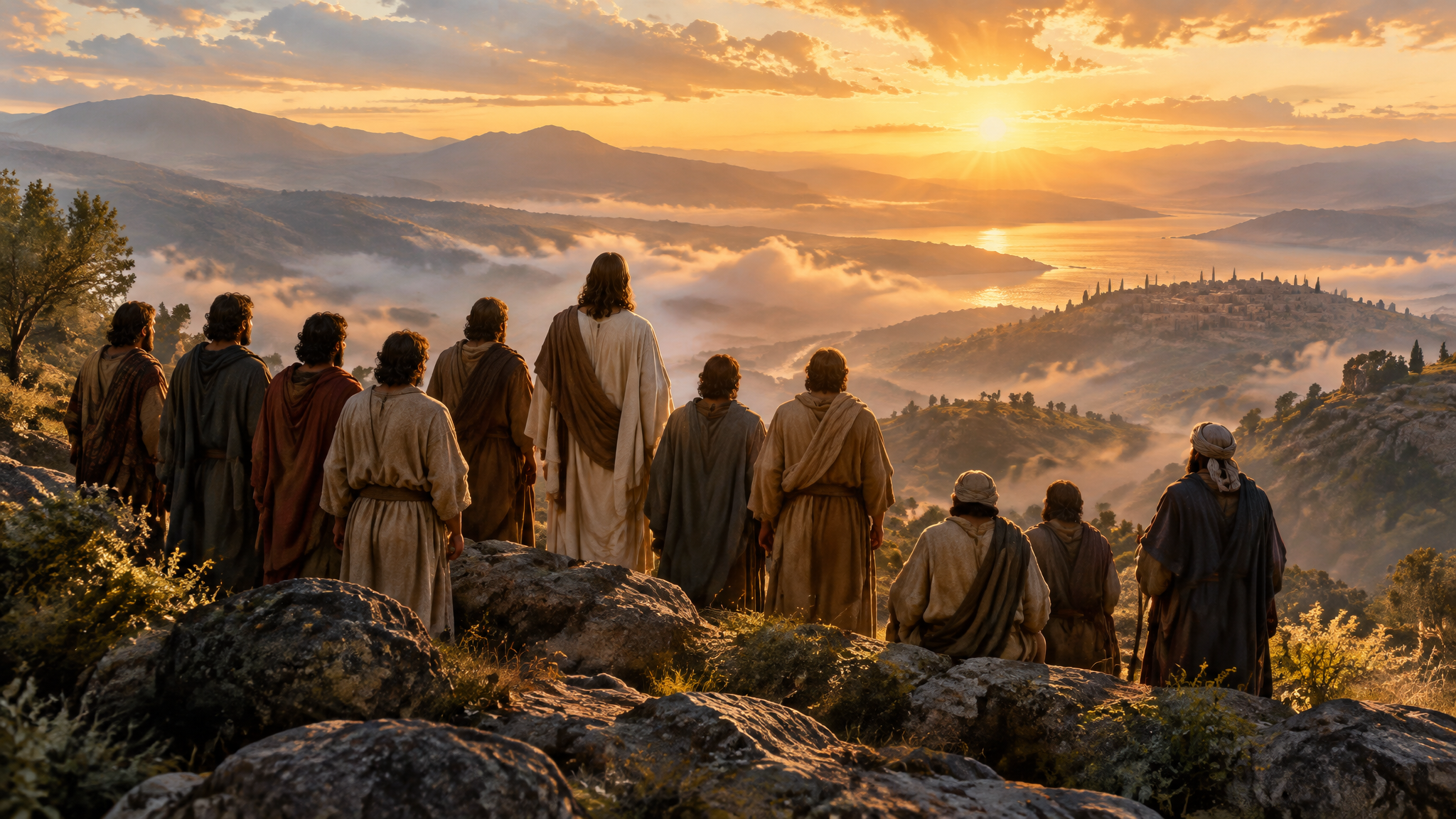
The scene opens not in a palace, but on a mountain in Galilee. The risen Jesus has summoned his eleven disciples there, and they come carrying both wonder and wounds. They have failed him, fled from him, and now stand before him again. Some worship. Some hesitate. Yet this is the moment when heaven’s King speaks a commission that will change the world.
Matthew 28:16-20 is not merely a farewell speech. It is the handing over of a kingdom mission. On this mountain, the crucified and risen Christ declares that all authority belongs to him. Then he sends imperfect followers to make disciples among all nations. Based on this passage, the Great Commission is not fuelled by human confidence, but by Christ’s authority, Christ’s command, and Christ’s abiding presence.
02 / 11
The Scripture
World English Bible (Public Domain)
03 / 11
The Context
Historical Context
Matthew’s Gospel was written in the first-century setting of the early church, when believers were learning how the life, death, and resurrection of Jesus fulfilled Israel’s story and launched a mission to the nations. This passage comes after the resurrection account. Jesus has been crucified under Roman power, buried, and raised. The women were told to inform the disciples that he would meet them in Galilee (Matthew 28:7, 10). Galilee matters because it is where much of Jesus’ public ministry began and where "Galilee of the Gentiles" already hinted at a wider horizon beyond Judea.
The eleven disciples are named as eleven because Judas is gone. That detail carries emotional and theological weight: this mission is entrusted to a reduced, bruised, imperfect band. Based on this passage, the church’s mission begins not with ideal people, but with restored followers of the risen Lord.
Cultural Context
In the ancient world, mountains often served as places of revelation. In Matthew especially, mountains are significant settings: the Sermon on the Mount, the Transfiguration, and now this commissioning scene. Readers would recognise the symbolic force. Jesus stands as the authoritative teacher and messianic King.
The command to make disciples of "all nations" would have sounded expansive and surprising. First-century Jewish expectation often centred on Israel’s restoration, though the Old Testament had long promised blessing for the nations through Abraham and the reign of God over all peoples. The mission is not merely to gather admirers but to form learners, apprentices, and obedient followers.
Baptism also had strong covenantal and identity-marking significance. To be baptised in the name of the Father, Son, and Holy Spirit is to be publicly identified with the God revealed in the gospel. Many Christian traditions understand this as one of the clearest Trinitarian formulas in the New Testament.
Literary Context
This passage is the climax of Matthew’s Gospel. Themes introduced earlier come to completion here. Jesus is "God with us" from the beginning (Matthew 1:23), and now he promises, "I am with you always". He taught with authority throughout the Gospel, and now he declares that all authority in heaven and on earth has been given to him. Disciples were first called to follow him in Galilee; now they are sent from Galilee to the world.
Many readers also notice that Matthew’s Gospel ends not with an account of ascension but with a promise of presence. Literarily, the final emphasis is not absence but nearness. The risen Christ reigns and remains with his people as they carry out his mission.
04 / 11
The Exposition
What does it say?
The passage begins with obedience: the eleven go to Galilee, to the mountain Jesus had appointed. When they see him, they worship, though some doubt or hesitate. Jesus then approaches them and speaks. His message unfolds in three major movements.
First, he declares his universal authority: "All authority has been given to me in heaven and on earth" (Matthew 28:18). Second, he commands them to make disciples of all nations, with participles that describe how this happens: going, baptising, and teaching. Third, he gives a promise: "I am with you always, even to the end of the age" (Matthew 28:20).
The main command is not merely "go" but "make disciples". The mission is deeper than travel, broader than conversion statistics, and longer than a single moment of response. It includes bringing people into the community marked by baptism and forming them through obedience to Jesus’ teaching.
What does it mean?
Based on this passage, the Great Commission rests on the risen Christ’s authority. Jesus does not speak as one teacher among many, but as the one to whom all authority in heaven and earth has been given. This echoes biblical language about God’s sovereign rule and resonates with texts such as Daniel 7:13-14.
The command to make disciples of all nations means the gospel is not ethnically narrow or geographically limited. The mission of Jesus reaches beyond Israel to every people group. Yet this is not a rejection of Israel’s story; rather, it is its fulfilment. God’s promise to bless all nations through Abraham finds a major expression here.
Baptising in the name of the Father, the Son, and the Holy Spirit shows that discipleship is entry into a new covenant identity shaped by the triune God. Teaching them to observe all that Jesus commanded makes clear that Christian faith is not merely intellectual assent. It is a life of obedience under Jesus’ lordship.
The phrase about some doubting is important. The text does not hide the disciples’ mixed response. The mission is given to worshippers who still struggle. Many Christian teachers have noted the comfort in this: uncertainty does not disqualify a person from being used by Christ.
Why does it matter?
This passage matters because it defines the church’s mission. Churches can become busy with many worthwhile activities, but Matthew 28:16-20 keeps the centre clear: the people of Jesus are called to make disciples. Evangelism, baptism, teaching, pastoral care, and global mission all gather under this purpose.
It also matters because it tells us why mission is possible. If the task depended mainly on human ability, it would fail. But mission stands on two unshakeable realities: Jesus has all authority and Jesus is with his people. The command is vast, but the foundation is greater.
What does it reveal about God?
Many Christian traditions understand this passage as revealing both the sovereignty of Christ and the triune name of God. Jesus possesses universal authority. He is not a local religious figure but the exalted Lord over heaven and earth.
The baptismal formula reveals God as Father, Son, and Holy Spirit. Christians differ on how fully the doctrine of the Trinity is developed at this point in the biblical storyline, yet most agree that this verse is profoundly important for Trinitarian theology. God is not distant in mission. He is the sender, the saving Lord, and the abiding presence.
The promise, "I am with you always," also reveals God’s covenant character. Throughout Scripture, God’s presence is a central gift to his people. Here, Jesus claims and gives that divine nearness.
What does it reveal about humanity?
Humanity is shown here as both needy and purposeful. The nations need discipling because people do not naturally live in obedient fellowship with God. We require reconciliation, instruction, transformation, and belonging.
At the same time, human beings are drawn into God’s mission. The disciples are fragile and imperfect, yet entrusted with a holy task. This passage presents people not as self-sufficient heroes but as dependent servants commissioned by grace.
The note that some doubted reveals the realism of Scripture. Human response can be mixed: reverence and hesitation may coexist. Yet Jesus addresses and commissions such people.
What does it mean for the believer?
For the believer, this passage means discipleship is both a gift and a calling. We are not only saved from sin; we are brought under the lordship of Jesus and into the life of the church. Baptism signifies belonging, and ongoing teaching signifies formation.
Believers are also sent. Not every Christian is called to the same role, but all are called to participate in Christ’s mission through witness, prayer, hospitality, generosity, service, and the passing on of Jesus’ teaching.
This passage also invites confidence. Our assurance does not come from our spiritual perfection. It comes from Christ’s authority and presence. Based on this passage, believers can obey even when they feel weak.
What does it look like in real life?
In real life, the Great Commission looks like a local church taking Jesus seriously enough to shape everything around disciple-making. It looks like someone sharing the gospel with a friend, a family teaching children the ways of Jesus, a pastor grounding new believers in Scripture, and a congregation supporting mission across cultures.
It looks like baptism services where new believers publicly identify with Christ. It looks like small acts of patient teaching: reading Scripture with someone, praying together, correcting gently, learning obedience in work, relationships, money, sexuality, suffering, and hope.
It also looks like crossing boundaries. "All nations" may mean global sending, but it also includes welcoming people nearby who come from different languages, histories, and backgrounds. The Great Commission is not fulfilled merely by preaching sermons; it is lived through forming communities where people learn to obey Jesus together.
And perhaps most tenderly, it looks like courage in weakness. The first disciples worshipped, and some hesitated. Yet Jesus still sent them. Many Christians today know that same mixture. The good news of this passage is that the mission does not begin with our strength. It begins with the risen Lord who comes near.
05 / 11
The Language
μαθητεύσατε (mathēteusate) — μαθητεύσατε
This is the central imperative in verse 19: "make disciples." It is more than getting decisions or gathering crowds. In Greek, it carries the sense of forming learners or apprentices. Based on this passage, the church’s mission is not complete when someone hears the gospel once; it aims at a life shaped by Jesus.
ἔθνη (ethnē) — ἔθνη
Usually translated "nations" or sometimes "Gentiles," this word points to peoples, ethnic groups, and the wider human family beyond Israel. In Matthew 28:19, it signals the global scope of Christ’s mission. Many interpreters note that this fulfils long-standing biblical hopes that God’s salvation would reach all peoples.
βαπτίζοντες (baptizontes) — βαπτίζοντες
Meaning "baptising," this participle shows one of the key ways disciples are marked out. Baptism signifies public identification with Christ and entry into the visible community of believers. Christian traditions differ on subjects and modes of baptism, but they broadly agree that baptism is a Christ-given sign closely tied to discipleship.
διδάσκοντες (didaskontes) — διδάσκοντες
This means "teaching." The task is not only proclamation but instruction. Importantly, Jesus says teaching them to observe all he commanded. The goal is obedient formation, not bare information. Many churches draw their teaching ministries from this pattern: doctrine joined to practice.
ἐξουσία (exousia) — ἐξουσία
Translated "authority," this word is crucial in verse 18. Jesus claims comprehensive authority in heaven and on earth. In Matthew’s Gospel, authority has been a recurring theme in his teaching, miracles, and forgiveness. Here it reaches its fullest expression in resurrection victory and universal lordship.
μεθ’ ὑμῶν (meth’ hymōn) — μεθ’ ὑμῶν
Meaning "with you," this phrase in verse 20 anchors the whole commission in presence. Jesus does not merely issue orders from afar. He promises nearness to his people. Many readers hear a deliberate echo of Matthew 1:23, "Immanuel," God with us. The Gospel begins and ends with presence.
06 / 11
The Connections
- Genesis 12:1-3 — God’s promise to bless all families of the earth through Abraham forms an important background to the mission to all nations.
- Daniel 7:13-14 — The Son of Man receives dominion, glory, and a kingdom; many scholars see this as resonating with Jesus’ claim to all authority.
- Matthew 1:23 — Jesus is called Immanuel, "God with us"; the promise in Matthew 28:20 completes this theme.
- Matthew 4:18-22 — The disciples were first called to follow Jesus in Galilee; now they are sent from Galilee in mature mission.
- Luke 24:46-49 — Luke’s commissioning passage also links the risen Christ, repentance, forgiveness, and the worldwide witness of the disciples.
- John 20:21-23 — "As the Father has sent me, even so I send you" highlights the missionary sending of the church grounded in Jesus’ own mission.
- Acts 1:8 — The promise of the Spirit and witness to the ends of the earth complements Matthew’s emphasis on worldwide mission and divine empowerment.
07 / 11
The Interpretations
Across major Christian traditions, there is strong agreement that Matthew 28:16-20 is a foundational mission text for the church. Catholics, Orthodox, Protestants, Evangelicals, Pentecostals, and many others affirm that the risen Jesus sends his followers to make disciples, baptise, and teach.
Roman Catholic interpretation often reads this passage in close connection with the sacramental life and the church’s teaching office. Baptism is seen as a sacrament of initiation into the life of Christ and his church, while the command to teach supports the church’s role in handing on apostolic faith.
Eastern Orthodox Christians also emphasise baptism, catechesis, and life in the communion of the church. The Great Commission is often understood not only as spreading information but as bringing people into participation in the life of the triune God through worship, formation, and holiness.
Reformed traditions strongly stress Christ’s universal authority and the centrality of disciple-making through Word and sacrament. They often highlight that the main command is to make disciples, and that the church’s mission includes teaching believers to obey all that Christ commanded.
Wesleyan and Arminian traditions commonly emphasise evangelism, holy living, and ongoing discipleship. They may particularly underline that teaching obedience involves transformation of life, not merely doctrinal instruction.
Pentecostal and Charismatic traditions strongly affirm the missionary scope of the passage and often connect it with Acts 1:8, stressing empowerment by the Holy Spirit for witness.
Differences arise especially around baptism: infant versus believer’s baptism, mode of baptism, and sacramental theology. There are also varying missional emphases: some stress church planting, others catechesis, social witness, or global evangelisation. Yet the broad consensus remains striking: Jesus, possessing all authority, commissions his people to bring the gospel to the nations and form obedient disciples in his enduring presence.
08 / 11
See It
Picture a master map spread across a wooden table. At first, only one small region is lit: Galilee. Around it stand eleven worn travellers. Their sandals are dusty, their faces lined with grief, hope, and uncertainty. Then the risen Jesus steps forward. As he speaks, the light begins to spread across the map—over Jerusalem, across deserts and seas, into cities, villages, islands, forests, and crowded streets.
Now place three objects beside the map: a crown, a basin of water, and an open scroll. The crown represents Christ’s authority: the mission begins with the King. The water represents baptism: people are brought into a new identity and community. The scroll represents teaching: disciples are formed by all that Jesus commanded.
Finally, imagine that as the eleven leave the mountain, a shadow does not fall behind them but walks with them. That is the promise of the passage. They do not go alone. The Great Commission is not a burden dropped on human backs; it is a journey carried out under the rule and presence of the risen Lord.
See It — Visual Demonstration
Sign in to visualiseArtistic imagining generated by AI — not a historical record. Pending human review.
09 / 11
Application
Make disciples, not just contacts
Based on this passage, the aim of Christian mission is deeper than brief religious encounters. Ask: am I helping people move towards lasting obedience to Jesus? This may include sharing the gospel, but also walking with someone patiently as they learn Scripture, prayer, repentance, and faithful living.
Live under Christ’s authority
Jesus begins with authority before he gives the command. A practical response is to place every area of life under his lordship: work, speech, relationships, ethics, money, and ambitions. The Great Commission is not only for missionaries abroad; it calls each believer to obey Jesus at home.
Value baptism and teaching
This passage joins baptism and teaching. Churches should not separate public commitment from ongoing formation. If you are a church leader, invest in catechesis, Bible teaching, mentoring, and pastoral care. If you are a believer, seek to be teachable and rooted, not merely inspired.
Embrace the nations near and far
"All nations" includes global mission and local hospitality. Pray for unreached peoples, support missionaries, and also welcome neighbours from different backgrounds. Many believers today can participate in the nations-coming-near through friendship, service, and gospel witness in their own towns.
Take courage from Christ’s presence
Some worshipped, and some doubted. Yet Jesus still commissioned them. If you feel weak, uncertain, or unqualified, this passage offers encouragement. Begin where you are. Pray, speak faithfully, serve humbly, and trust that Christ is with his people even to the end of the age.
10 / 11
Reflect
- What stands out most to you in Jesus’ words: his authority, his command, or his promise of presence?
- How does the phrase "make disciples" challenge a shallow understanding of Christian mission?
- In what ways does your church or fellowship embody both baptism and teaching as part of discipleship?
- Where do you sense hesitation or doubt in your own walk, and how does this passage encourage you?
- What might "all nations" mean in your local context as well as globally?
- What is one practical step you can take this week to participate more intentionally in Christ’s mission?
11 / 11
Pray
Lord Jesus Christ, thank you that all authority in heaven and on earth belongs to you. Thank you that you call imperfect people into your holy mission. Please teach me to live as your disciple and to help others follow you with sincerity and obedience.
Give me courage to speak of you, patience to teach what you have commanded, and humility to serve in love. Help your church to welcome the nations, treasure baptism, and remain faithful to your Word. Where I feel weak or hesitant, remind me that your presence is enough. Based on this passage, I ask that my life would be shaped by your authority, your mission, and your promise: that you are with your people always, even to the end of the age. Amen.
Finished the exposition?
Mark it complete to update your journey and streak.
This teaching explores Matthew 28:16-20, where the risen Jesus sends his disciples with a world-embracing mission. Based on this passage, we see Christ’s authority, the call to make disciples, and the enduring promise of his presence with his people.