Matthew 5:14-16
You Are the Light of the World
Shining in ordinary places so others may see the Father’s goodness
Video teaching coming soon
01 / 11
Introduction
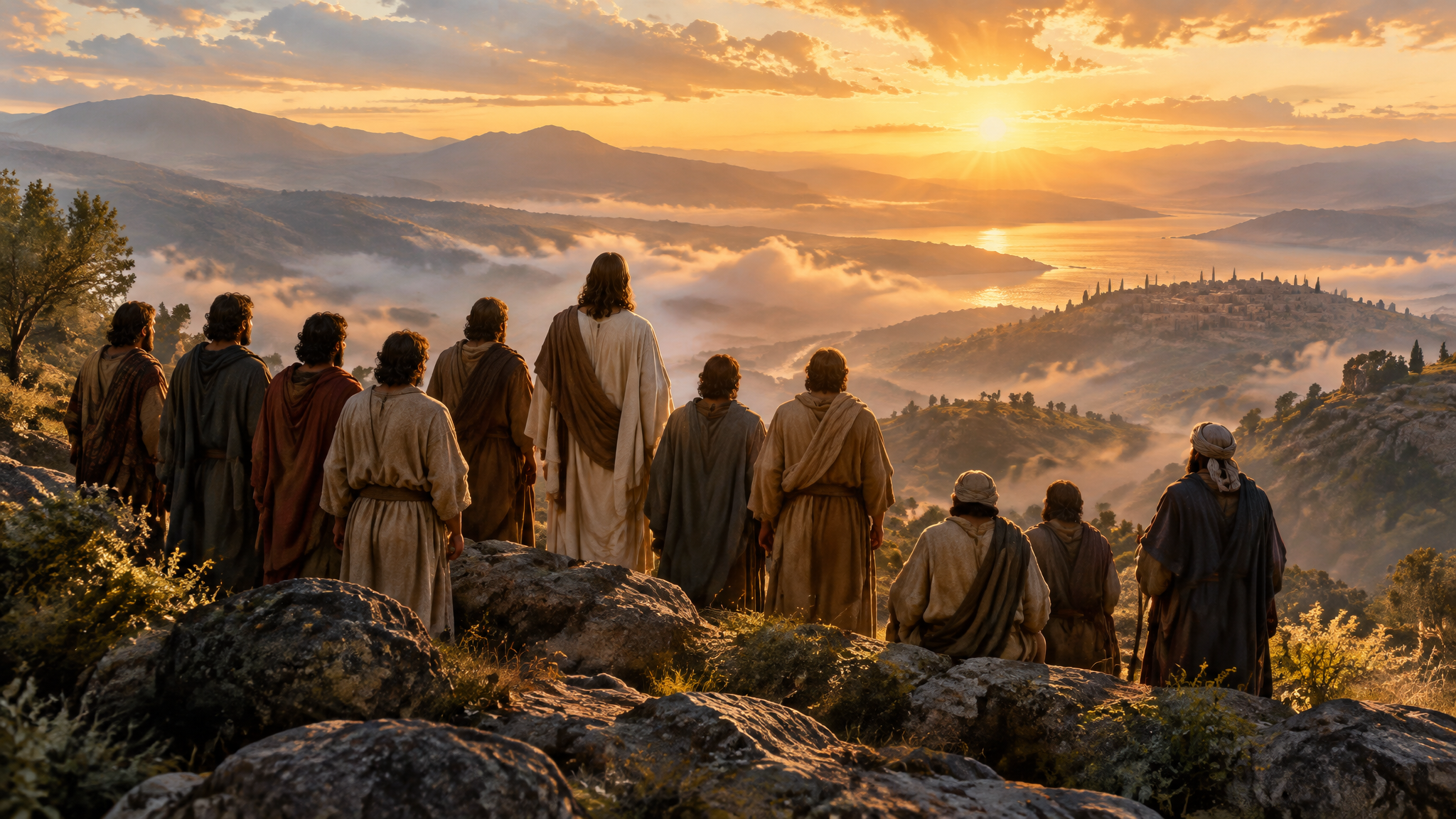
Imagine dusk settling over the hills of Galilee. The heat of the day begins to fade, and small lamps flicker to life in homes scattered across the landscape. In the distance, a town perched on a rise catches the last light and then begins to glow against the darkening sky. People can see it from far away. Closer by, inside a simple house, one small oil lamp is lifted onto its stand, and suddenly the whole room changes. Faces become visible. Pathways appear. Work can continue. Meals can be shared.
Based on this passage, Jesus takes those familiar sights and turns them into a calling. He looks at ordinary disciples and gives them extraordinary language: you are the light of the world. Not hidden, not private, not meant for self-display, but meant to shine in such a way that people are drawn beyond the disciple to the glory of the Father.
02 / 11
The Scripture
World English Bible (Public Domain)
03 / 11
The Context
Historical Context
Matthew 5:14–16 comes near the beginning of the Sermon on the Mount, one of the most concentrated collections of Jesus’ ethical teaching in the Gospel of Matthew. Jesus is speaking in Galilee, a region shaped by Jewish faith, Roman rule, and daily economic struggle. His audience likely includes disciples close at hand and crowds listening beyond them. In Matthew’s Gospel, Jesus is presented as the Messiah who fulfils Israel’s story and teaches with deep authority. These verses follow immediately after the Beatitudes and the declaration that disciples are the salt of the earth (Matthew 5:3–13). That matters because the “light” image is not detached from character. The kind of people who shine are the poor in spirit, the merciful, the pure in heart, the peacemakers, and those who endure persecution.
Cultural Context
In the ancient world, darkness was not merely symbolic; it was a practical daily reality. After sunset, light came from small oil lamps, and even one lamp could significantly brighten a room. A lamp was not lit to be covered with a basket or container; that would defeat its purpose. Likewise, a city on a hill was naturally conspicuous. Elevated settlements could often be seen from a distance, especially when lights appeared at night. Jesus uses images from everyday village life, making his point immediately understandable.
The phrase “good works” would also resonate in a Jewish moral framework. Works of mercy, justice, generosity, and covenant faithfulness were not meant as self-salvation projects but as visible expressions of devotion to God. Yet Jesus also warns elsewhere against practising righteousness “to be seen by men” for human praise (Matthew 6:1). So already we can sense a tension that Jesus will clarify: visible obedience is good when it leads observers to glorify God, not the performer.
Literary Context
Literarily, this passage sits in a key movement of identity and vocation. Jesus first names what his disciples are: salt and light. He then unfolds what kingdom righteousness looks like throughout Matthew 5–7. The imagery of light echoes biblical themes from Isaiah and the Psalms, where God is light and his people are called to reflect his ways among the nations. Based on this passage, discipleship in Matthew is both inward and outward: transformed hearts produce visible lives. The flow of the sermon suggests that kingdom identity always becomes public testimony.
04 / 11
The Exposition
What does it say?
Jesus makes three linked statements. First, “You are the light of the world.” He does not begin with “try to become light” but with a declaration about the identity of his disciples. Second, he uses two images to show that light is meant to be seen: a city on a hill cannot be hidden, and a lamp is placed on a stand to give light to everyone in the house. Third, he gives a command flowing from that identity: “let your light shine before men”, with a purpose clause attached—that they may see your good works and glorify your Father who is in heaven.
So the passage moves from identity, to imagery, to mission. Jesus describes who the disciples are, explains the visible nature of that calling, and directs the outcome toward the glory of God.
What does it mean?
Based on this passage, “light” refers to the visible impact of a life shaped by Jesus. In Scripture, light often carries meanings such as truth, holiness, purity, revelation, guidance, and life. Here the stress falls especially on public witness through good works. These are not random acts done for applause, but deeds consistent with the kingdom values Jesus is teaching.
Many Christian traditions understand this passage in relation to Jesus himself, who is uniquely the light in a foundational sense (for example, John 8:12). Believers are not the source of light independently; rather, they shine because they belong to him and bear his character. The moon does not generate light, but it reflects the sun. In a similar way, disciples reflect the life and truth of Christ.
The command to shine “before men” does not contradict Jesus’ later warning about religious showmanship. The difference lies in motive and result. One kind of visibility seeks admiration for self. The other kind of visibility leads people to glorify your Father who is in heaven. The disciple is visible, but the Father is central.
Why does it matter?
It matters because Jesus refuses a private-only faith. The kingdom of God is personal, but never merely private. A hidden discipleship may feel safer, but it does not match the imagery Jesus gives. Cities are seen. Lamps are placed where they can help others. Christian witness includes words, but in this passage it clearly includes conduct that others can observe.
This also matters because the world is described as needing light. Darkness in biblical imagery can refer to confusion, evil, injustice, ignorance, fear, and alienation from God. Jesus sends his people into that reality not simply to condemn it, but to illuminate it through lives of mercy, integrity, truthfulness, reconciliation, and compassion.
What does it reveal about God?
This passage reveals God as Father—not in a vague universal sense detached from Jesus’ teaching, but as the heavenly Father whom disciples know and whose glory is their aim. The Father is worthy of public honour. He is not diminished when his people do good; rather, their faithfulness becomes a window through which others may recognise his goodness.
The passage also reveals God’s missionary heart. He intends his people to be a blessing that can be seen. This echoes Old Testament themes in which Israel was called to display God’s wisdom and righteousness among the nations. God’s character is not meant to remain obscured; it is meant to be made known.
What does it reveal about humanity?
It reveals that human beings are deeply influenced by what they see. Jesus assumes that people observe the lives of others and draw conclusions from them. Conduct teaches. Communities signal meaning. Visible goodness can awaken questions, soften hostility, and provoke praise to God.
At the same time, the passage hints at a human danger: we can turn good deeds into self-promotion. Humanity is capable both of reflecting God and of stealing attention from him. That is why motive matters so much.
What does it mean for the believer?
For the believer, this means discipleship is inherently representational. To belong to Jesus is to live in a way that makes something of God visible. This does not require fame, platform, or spectacle. A lamp shines in a house. A city shines where it is built. The point is faithful presence where God has placed us.
It also means good works are not optional extras. They do not earn God’s love, but they do express kingdom life. Many Christian traditions emphasise this in complementary ways: some stress good works as evidence of genuine faith, others as cooperation with grace, others as Spirit-empowered witness. In all cases, visible obedience matters.
What does it look like in real life?
It looks like a business owner choosing honesty when deceit would be more profitable. It looks like a student refusing cruelty and including the lonely. It looks like a family practising hospitality. It looks like a church serving its neighbourhood without needing applause. It looks like truth spoken with gentleness, generosity offered quietly, and moral courage exercised with humility.
Sometimes shining is dramatic, like costly obedience under pressure. Often it is ordinary, repeated faithfulness: keeping promises, forgiving an offender, caring for the vulnerable, treating workers fairly, refusing gossip, praying for enemies, giving to those in need. The light is not in theatrical spirituality but in embodied kingdom character.
Based on this passage, the final goal is never “Look at those impressive Christians.” It is, “Glory to the Father in heaven.” The best Christian witness is visible enough to be noticed and humble enough to redirect the praise.
05 / 11
The Language
φῶς (phōs) — φῶς
Meaning: light. In Greek, this term can refer to literal light, but in biblical usage it often carries moral and spiritual significance: truth, purity, revelation, and life. In Matthew 5:14, the disciples are called “the light of the world.” The significance is profound. Based on this passage, believers are not merely holders of information; they are meant to be a visible, illuminating presence.
κόσμος (kosmos) — κόσμος
Meaning: world. This can refer to the created order, human society, or the inhabited world. Here it points to the broader human sphere in which disciples live and witness. Jesus does not say believers are only light to one another. Their calling extends outward. The scope is expansive and mission-oriented.
λύχνος (lychnos) — λύχνος
Meaning: lamp. This refers to a small oil lamp used in an ordinary home. The image is domestic and practical, not grand. Its significance lies in purpose: a lamp is lit in order to give light. The metaphor suggests usefulness, placement, and intentional visibility. A hidden lamp fails in its function.
καλὰ ἔργα (kala erga) — καλά ἔργα
Meaning: good works or beautiful/noble deeds. The adjective can imply not only moral goodness but something attractive or commendable. These works are not merely technically correct actions; they are the kind of deeds that visibly embody God’s goodness. Many Christian traditions note that these works do not replace faith, but demonstrate its fruit.
δοξάσωσιν (doxasōsin) — δοξάσωσιν
Meaning: that they may glorify. This verb points to giving honour, praise, or recognition. The purpose of the disciple’s visible life is theological, not ego-driven. The end point is not self-congratulation but worship directed to “your Father in heaven.” This word is crucial for guarding interpretation: Christian visibility must be doxological, aimed at God’s glory.
06 / 11
The Connections
- Isaiah 42:6 — God’s servant is called to be a light to the nations, forming an important Old Testament background for the idea of God’s people bearing light outward.
- Isaiah 49:6 — The mission of God extends beyond Israel to the nations; many Christians see this fulfilled in Christ and shared with his people.
- Psalm 27:1 — The Lord himself is described as light, reminding us that any light in believers is derivative, not self-generated.
- John 8:12 — Jesus says he is the light of the world; this helps frame Matthew 5 so that disciples shine by relation to him.
- Philippians 2:14–16 — Believers are called to shine as lights in the world while holding fast the word of life, closely echoing Jesus’ imagery.
- 1 Peter 2:12 — Christians are urged to live honourably among the nations so that observers may glorify God, a strong thematic parallel to Matthew 5:16.
- Ephesians 5:8–9 — Paul says believers were once darkness but are now light in the Lord, and should walk accordingly in goodness, righteousness, and truth.
07 / 11
The Interpretations
Across major Christian traditions, there is strong agreement that Matthew 5:14–16 teaches the public, visible character of Christian discipleship. Catholics, Orthodox, Reformed, Wesleyan/Arminian, and Pentecostal believers all commonly affirm that the disciple’s life should reflect Christ in ways that bless others and bring glory to God.
Where traditions may differ is mainly in emphasis. Catholic interpretation often highlights the relationship between grace, virtue, and good works: works do not originate from autonomous human effort but from grace-enabled participation in God’s life. Orthodox readers frequently place this passage within the broader theme of transformation into Christlikeness, seeing light as the visible radiance of a life being healed and sanctified in communion with God.
Reformed traditions typically stress that good works are the fruit and evidence of saving faith, not the basis of justification. Thus, shining before others demonstrates the reality of grace already received. Wesleyan/Arminian traditions often emphasise holiness of life, practical love, and cooperative obedience, seeing this passage as a call to active discipleship shaped by sanctifying grace.
Pentecostal traditions commonly read the text with a strong missional dimension, linking the believer’s visible life with Spirit-empowered witness in both deed and proclamation.
There is also broad agreement that this passage must be read alongside Matthew 6:1. Christians should do good visibly when faithfulness requires it, but should not perform righteousness to attract praise. The unifying interpretation is that the believer’s life should be noticeable for the right reason: not self-exaltation, but the Father’s glory. Many Christian traditions understand this as the balance of humble visibility—public faithfulness without spiritual vanity.
08 / 11
See It
Picture a dark room large enough for several people to stand in, but with the curtains drawn and the lights off. At first, everyone is cautious. Movements are slow. Faces cannot be clearly recognised. Objects are uncertain shapes. Then place a single small oil-lamp replica—or in a modern setting, a single warm lantern—on a stand in the centre of the room. Instantly, the atmosphere changes. The light is not harsh, but it is enough. People can see one another. They can navigate. They can gather around the light. The room feels safer, warmer, more human.
Now take a basket or box and place it over the lamp. The room dims again. Nothing is wrong with the lamp itself; the problem is that it has been covered. Then lift the covering and let the light shine once more.
Based on this passage, the lesson becomes visible: the issue is not whether light exists, but whether it is allowed to fulfil its purpose. Jesus’ words ask each believer and each church: are we positioned to illuminate, or are we obscured by fear, compromise, comfort, or self-concern?
See It — Visual Demonstration
Sign in to visualiseArtistic imagining generated by AI — not a historical record. Pending human review.
09 / 11
Application
Live visibly, not theatrically
Jesus does not call believers to self-advertisement, but neither does he permit a hidden obedience that avoids all public cost. Ask: where am I shrinking back from visibly identifying with Christ through conduct, speech, or compassion? Faithfulness should be noticeable, even when it is quiet.
Practise good works that point beyond yourself
Choose actions that serve real needs: generosity, hospitality, honesty, peacemaking, care for the poor, encouragement of the lonely. Then guard your heart. The goal is not to build a personal image of goodness, but to let others glimpse the Father’s character through what they see.
Remove the basket
Sometimes the light is obscured by fear of people, hypocrisy, unresolved sin, bitterness, or spiritual passivity. Prayerfully identify what is covering your witness. Based on this passage, Jesus assumes the lamp belongs on a stand. Repentance and renewed obedience are often how the covering is lifted.
Shine where you already are
A lamp shines in the house where it is placed. You do not need a dramatic new setting to obey this text. Start in your present relationships: home, workplace, school, church, neighbourhood. Small acts of truth and love, repeated consistently, can become a powerful witness over time.
Aim for the Father’s glory
Before serving, speaking, or posting, ask a simple question: who will get the attention? Christian witness is healthiest when it is consciously offered to God. Many believers find it helpful to pray before acts of service: “Father, let this reflect you.” That habit reorders motive and keeps the heart from vanity.
10 / 11
Reflect
- When you hear Jesus say, “You are the light of the world,” what encourages you and what unsettles you?
- In your current season of life, where is your light most visible—home, work, church, friendships, or public life?
- What “good works” are most needed in the environments where God has placed you?
- Is there any “basket” currently covering your witness, such as fear, compromise, pride, or exhaustion?
- How can you live more publicly faithful without becoming performative or attention-seeking?
- What would it look like this week for someone to see your life and be moved to glorify your Father in heaven?
11 / 11
Pray
Father in heaven, thank you for the words of Jesus that call your people to shine. Please form in me the kind of life that reflects your goodness with honesty, humility, and courage. Where I have hidden out of fear, draw me into faithful visibility. Where I have wanted praise for myself, correct my motives and turn my heart toward your glory.
Help me to practise good works that are shaped by love, truth, mercy, and holiness. Let my words and actions make room for others to see something of your character. In ordinary places and difficult moments, teach me to live as a light that points beyond itself. May whatever is seen in me lead to honour for you, my Father in heaven. Amen.
Finished the exposition?
Mark it complete to update your journey and streak.
In Matthew 5:14–16, Jesus tells his disciples that their lives are meant to be visible, illuminating, and God-glorifying. This teaching explores how faithful presence, good works, and public witness come together so that the light seen in believers points beyond them to the Father in heaven.